Valid AZ-204 Dumps shared by PassLeader for Helping Passing AZ-204 Exam! PassLeader now offer the newest AZ-204 VCE dumps and AZ-204 PDF dumps, the PassLeader AZ-204 exam questions have been updated and ANSWERS have been corrected, get the newest PassLeader AZ-204 dumps with VCE and PDF here: https://www.passleader.com/az-204.html (644 Q&As Dumps)
BTW, DOWNLOAD part of PassLeader AZ-204 dumps from Cloud Storage: https://drive.google.com/open?id=1_dGx5coDJPG4zq5xvUhc2LmfQ-jO_xyp
NEW QUESTION 621
You are developing an application that needs to react to events from multiple Azure services, such as Azure Blob Storage and Azure Resource Manager, in near-real time. The application must meet the following requirements:
– Handle a high volume of events without manual intervention.
– Receive only specific events relevant to your application, based on event types or resource patterns.
– Ensure that no events are missed, even if the processing application is temporarily unavailable.
– Use Azure Functions for processing events without managing any infrastructure.
– Minimize the amount of custom code required for event routing and handling.
You need to develop the solution.
Solution: Deploy an Azure Service Bus namespace. Configure the Azure services to send events to the Service Bus. Implement Azure Functions with Service Bus triggers to process the events. Use Service Bus sessions and message deferral to manage event ordering and reliability.
Does the solution meet the goal?
A. Yes
B. No
Answer: B
Explanation:
Set up Azure Event Hubs to receive events from the Azure services. Develop a custom application using Azure Functions with Event Hub triggers to process the events. Implement custom filtering logic within the functions to select relevant events. For handling a high volume of events with complicated logic in conjunction with Azure Functions, Azure Event Hubs is generally the best choice. While Azure Service Bus and Azure Logic Apps can also handle events, Event Hubs is specifically designed for high-throughput, real-time data ingestion and processing, making it well-suited for scenarios involving large volumes of events. Logic Apps, while powerful for workflow automation, might not be as efficient for handling the sheer scale of events that Event Hubs can manage.
https://cosmin-vladutu.medium.com/azure-event-grid-vs-azure-service-bus-vs-event-hubs-when-to-use-each-12900bb32ce8
NEW QUESTION 622
You are developing an application that needs to react to events from multiple Azure services, such as Azure Blob Storage and Azure Resource Manager, in near-real time. The application must meet the following requirements:
– Handle a high volume of events without manual intervention.
– Receive only specific events relevant to your application, based on event types or resource patterns.
– Ensure that no events are missed, even if the processing application is temporarily unavailable.
– Use Azure Functions for processing events without managing any infrastructure.
– Minimize the amount of custom code required for event routing and handling.
You need to develop the solution.
Solution: Configure Azure Event Grid system topics for each Azure service. Create event subscriptions with Advanced Filters to receive only the relevant events. Use Azure Functions with Event Grid triggers to process the events. Enable Dead-lettering on the event subscriptions to handle failures and ensure reliable delivery.
Does the solution meet the goal?
A. Yes
B. No
Answer: A
Explanation:
Configure Azure Event Grid system topics for each Azure service. Create event subscriptions with Advanced Filters to receive only the relevant events. Use Azure Functions with Event Grid triggers to process the events. Enable Dead-lettering on the event subscriptions to handle failures and ensure reliable delivery. Using system topics, advanced filters, Event Grid triggers, and dead-lettering allows Azure Event Grid to handle high volumes of events by enabling efficient routing, scalable delivery, and reliable message handling. Advanced filters and resource patterns ensure that only relevant events are delivered to subscribers, while Event Grid triggers enable serverless functions to react to events at scale. Dead-lettering provides a safety net for messages that cannot be delivered, ensuring high availability and reliability.
https://cosmin-vladutu.medium.com/azure-event-grid-vs-azure-service-bus-vs-event-hubs-when-to-use-each-12900bb32ce8
NEW QUESTION 623
You are developing a microservices-based application that uses Azure Container Apps. The application consists of several containerized services that handle tasks, such as processing orders, managing inventory, and generating reports. You deploy a new revision of the processing orders app. Processing orders must be triggered by a web request and must always be available based on incoming web requests. You need to validate that the replica is ready to handle incoming requests. What should you implement?
A. HTTP readiness probe
B. TCP readiness probe
C. HTTP startup probe
D. TCP liveness probe
E. HTTP liveness probe
Answer: A
Explanation:
Azure Container Apps health probes allow the Container Apps runtime to regularly inspect the status of your container apps. You can set up probes using either TCP or HTTP(S) exclusively.
https://learn.microsoft.com/en-us/azure/container-apps/health-probes
NEW QUESTION 624
You are developing a microservices-based application that uses Azure Container Apps. The application consists of several containerized services that handle tasks, such as processing orders, managing inventory, and generating reports. You deploy two microservices named serviceA and serviceB to support managing inventory. You have the following requirements:
– serviceA and serviceB must publish events to a single Azure Event Hub by using the Event Hubs SDK.
– serviceA must publish 1,000 events per second.
– serviceB must publish 3,000 events per second.
– Costs must be minimized.
You need to support the publishing of events. What should you do?
A. Create four partitions. Update serviceA to use one partition and serviceB to use three partitions.
B. Enable and configure Azure Event Hubs Capture.
C. Create an Azure Event Hubs dedicated cluster. Configure the capacity units to one and the scaling units to two.
D. Create and configure an Azure Schema Registry in Event Hubs. Update serviceA and serviceB to validate message schemas.
E. Create four consumer groups. Update serviceA to use one consumer group and serviceB to use three consumer groups.
Answer: A
Explanation:
There are two factors that influence scaling with Event Hubs:
– Throughput units (standard tier) or processing units (premium tier).
– Partitions.
https://learn.microsoft.com/en-us/azure/event-hubs/event-hubs-scalability
NEW QUESTION 625
You are developing an Azure Function app for scalability and integration with Azure Blob Storage. You must run the code in an Azure production environment that allows the function to scale based on demand, providing instance size selection and higher concurrency control. The function must connect to other Azure services secured inside a virtual network, scale to zero instances when there are no incoming events and minimize costs. You need to select a hosting plan to meet the requirement. Which plan should you use?
A. Flex Consumption
B. Consumption
C. Premium
D. Dedicated
Answer: A
Explanation:
Flex Consumption is a Linux-based Azure Functions hosting plan that builds on the Consumption pay for what you use serverless billing model. It gives you more flexibility and customizability by introducing private networking, instance memory size selection, and fast/large scale-out features still based on a serverless model.
https://learn.microsoft.com/en-us/azure/azure-functions/flex-consumption-plan
NEW QUESTION 626
You have a workspace-based Azure Application Insights resource named Insights1 and an Azure App Service Web App named App1. Insights1 collects telemetry generated by App1. You plan to evaluate the alerting functionality of the availability testing that is enabled for App1 by taking it offline for 50 minutes. You create a standard availability test for App1, set its frequency to 15 minutes, and set its alert status to Enabled. You need to assess the number of alerts that you should expect by taking App1 offline for 50 minutes. How many alerts should you expect?
A. 1
B. 2
C. 3
D. 4
Answer: B
Explanation:
A notification is sent sometime between 15 to 30 minutes. A second notification is sent sometime between 31 to 45 minutes.
https://learn.microsoft.com/en-us/azure/azure-monitor/alerts/alerts-overview
NEW QUESTION 627
You are a developer for a company that recently transitioned to using workspace-based Application Insights for a C# .NET web application that runs on Azure. The application has intermittent performance issues. You need to use the AI-powered code analysis feature in Application Insights to help diagnose the problem. What should you do?
A. Enable and configure smart detection.
B. Enable and configure availability tests.
C. Use the Application Map to visualize dependencies and interactions, then trace the performance issues through the map.
D. Enable the profiler and snapshot debugger.
E. Configure continuous export of telemetry data to Azure Storage.
Answer: D
Explanation:
1. Code Optimizations and Application Insights Profiler for .NET.
– The .NET Profiler and Code Optimizations work together to provide a holistic approach to performance issue detection.
– Code Optimizations, an AI-based service in Azure Application Insights, works in tandem with the Application Insights Profiler for .NET to detect CPU and memory usage performance issues at a code level and provide recommendations on how to fix them.
2. Code analysis.
– .NET Profiler: Capture, identify, and view performance traces for your application.
– Code optimizations: Harness AI to create better and more efficient applications.
– Snapshot debugger: Automatically collect debug snapshots when exceptions occur in .NET application.
https://learn.microsoft.com/en-us/azure/azure-monitor/insights/code-optimizations-profiler-overview
https://learn.microsoft.com/en-us/azure/azure-monitor/app/app-insights-overview
NEW QUESTION 628
A large retail company operates online and physical stores. The company tracks inventory levels in real time to manage stock efficiently across all locations. You develop an Azure Event Grid solution to handle events generated by the inventory management system deployed to Azure. You need to implement a subscription filter that dynamically adjusts to seasonal changes in product demand. Which event filter should you use?
A. An advanced filter using a Boolean condition that evaluates multiple data fields, including a season field within the event data.
B. A prefix filter on the event type field that matches the current season’s name.
C. A subscription filter that uses label filter to include events tagged with seasonal promotional codes.
D. A static subject filter that targets events with a subject ending in “/seasonal/inventory”.
Answer: A
Explanation:
An advanced filter in Azure Event Grid allows you to define complex filtering logic that can evaluate multiple fields in the event data, including custom fields like “season”. This flexibility is ideal for handling scenarios where product demand varies dynamically depending on seasons. By evaluating fields such as a “season” field within the event data, you can adjust inventory management in real time based on the current season and product demand trends.
NEW QUESTION 629
You have an Azure Service Bus namespace with a partitioned queue named queue1. You plan to send a large number of messages through queue1 over the next few weeks. The order of messages will be random. You must minimize the possibility of message transmission interruption by transient failures of individual partitions. You need to use the optimal configuration of the partition key in the messages. Which configuration should you use?
A. Set the partition key of messages to the message ID value.
B. Enable sessions. Set the partition key of messages to the session ID value.
C. Enable sessions. Ensure that the partition key is different from the session ID value.
D. Leave the partition key value as null.
Answer: D
Explanation:
https://learn.microsoft.com/en-us/azure/service-bus-messaging/service-bus-partitioning
https://learn.microsoft.com/en-us/azure/event-hubs/event-hubs-availability-and-consistency
NEW QUESTION 630
You plan to deploy an Azure Container app. You need to configure the container app to support session affinity. Which ingress type and revision mode should you assign to the container app?
A. HTTP ingress type and multiple revision mode.
B. HTTP ingress type and single revision mode.
C. TCP ingress type and multiple revision mode.
D. TCP ingress type and single revision mode.
Answer: B
Explanation:
For an Azure Container App requiring session affinity, you should use HTTP ingress and Single revision mode. Session affinity, also known as sticky sessions, is only supported when using HTTP ingress and when the container app is in single revision mode.
https://learn.microsoft.com/en-us/azure/container-apps/sticky-sessions
NEW QUESTION 631
You have an on-premises, public-facing website named www.contoso.com. You plan to test availability of www.contoso.com by using Application Insights availability tests. You need to configure a test that will generate HTTP POST requests that include custom headers. Your solution must minimize development effort. Which type of test should you configure?
A. Multi-step web test.
B. Standard test.
C. URL ping test.
D. Custom TrackAvailability test.
Answer: B
Explanation:
Standard test is a type of availability test that checks the availability of a website by sending a single request, similar to the deprecated URL ping test. In addition to validating whether an endpoint is responding and measuring the performance, Standard tests also include TLS/SSL certificate validity, proactive lifetime check, HTTP request verb (for example, GET,HEAD, and POST), custom headers, and custom data associated with your HTTP request.
https://learn.microsoft.com/en-us/azure/azure-monitor/app/availability
NEW QUESTION 632
You have a workspace-based Azure Application Insights resource named Insights1 and an Azure App Service Web App named App1. Insights1 collects telemetry generated by App1. You plan to test the availability of App1 by using Insights1. The test must include the following tasks:
– Parse dependent requests.
– Validate TLS certificates.
– Configure custom request headers.
You must minimize development and implementation efforts. You need to implement the Application Insights availability test that will deliver the required functionality. Which availability test should you implement?
A. Custom TrackAvailability test.
B. Standard test.
C. URL ping test.
D. Multi-step web test.
Answer: B
Explanation:
For parsing dependent requests, validating TLS certificates, and configuring custom request headers in an Azure Application Insights availability test on an App Service Web App, the Standard test is the most appropriate choice.
https://learn.microsoft.com/en-us/azure/azure-monitor/app/availability
NEW QUESTION 633
You manage an Azure App Service Web App named App1 and an associated Azure Application Insights resource named AppInsights1. You require alerts about any unusual rate increase of failed HTTP requests targeting App1. You need to implement push notifications. What should you do?
A. Deploy an Azure Resource Manager template that configures AppInsights1.
B. From the Azure portal, modify an action group of Azure Monitor.
C. From the Azure portal, modify diagnostic settings of AppInsights1.
D. Deploy an Azure Resource Manager template that configures the analyticsItems child resource of AppInsights1.
Answer: B
Explanation:
To implement push notifications for an unusual increase in the rate of failed HTTP requests for an Azure App Service Web App using Azure Application Insights, you can configure an alert rule that monitors the failed request rate and triggers an action group when a threshold is exceeded. This action group can then send notifications through various channels, including email, SMS, or webhook to trigger a push notification.
https://learn.microsoft.com/en-us/azure/azure-monitor/alerts/action-groups
NEW QUESTION 634
You are developing a set of RESTful APIs that will be consumed by external partners. You must expose the APIs securely through Azure API Management. You have the following requirements:
– Only authenticated and authorized clients must be able to access the APIs.
– Control over the number of API calls to prevent abuse and ensure fair usage must be implemented.
– Data transformation and validation on incoming requests and outgoing responses must be performed without modifying the back-end services.
– Insights into API usage patterns, performance metrics, and anomaly detection must be gathered.
You need to implement the APIs. What should you do?
A. Use basic authentication over HTTPS.
Apply IP filtering policies.
Perform transformation logic in the client application.
Enable Azure diagnostics logs.
B. Use OAuth 2.0 for authentication and authorization.
Apply rate limit policies.
Use inbound and outbound policies for transformation.
Enable Azure Monitor for detailed analytics.
C. Require clients to present client certificates.
Use response caching policies.
Implement request and response transformation in back-end services.
D. Use subscription keys for authentication.
Implement caching policies.
Modify API code for transformation.
Use Application insights for monitoring.
Answer: B
Explanation:
https://datadome.co/bot-management-protection/what-is-api-rate-limiting/
https://learn.microsoft.com/en-us/azure/api-management/api-management-sample-send-request
NEW QUESTION 635
You have an Azure subscription named Sub1 that contains a resource group named RG1 and a Service Bus queue named SB1. You plan to implement an Azure Event Grid push event subscription that will deliver an event to SB1 whenever a resource is created, modified, or deleted in RG1. You must minimize the development and configuration efforts. You need to create an Event Grid topic for your planned implementation. Which type of event topic should you create?
A. event domain
B. custom
C. system
D. namespace
Answer: C
Explanation:
For Azure Event Grid push event subscriptions where events related to resource creation, modification, or deletion are needed, system topics should be used. System topics are built-in topics provided by Azure services like Azure Storage, Event Hubs, and Service Bus, and they automatically publish events when these resources change. System topics are automatically created and managed by Azure services for specific resource types. When a resource within that type changes (e.g., a blob is created in a storage account), the system topic automatically publishes an event.
https://learn.microsoft.com/en-us/azure/event-grid/concepts
NEW QUESTION 636
You manage an Azure Storage account named storage1. You plan to load 1 million blobs into storage1. You must assign key-value pairs to blobs so that both keys and their values are automatically indexed and searchable by using the built-in services of storage1. You need to run the command to assign key-value pairs. Which command should you run?
A. az storage blob tag set
B. az storage blob service-properties update
C. az storage blob directory metadata update
D. New-AzStorageBlobQueryConfig
Answer: A
Explanation:
https://learn.microsoft.com/en-us/azure/storage/blobs/storage-blob-index-how-to
https://learn.microsoft.com/en-us/cli/azure/storage/blob/tag
NEW QUESTION 637
You have 100 Azure virtual machines (VMs) with the system-assigned managed identity enabled. You need to identify the value of the object ID attribute for each of the identities. Which command should you use?
A. Get-AzVM
B. Get-AzureADUserOwnedObject
C. az ad sp credential list
D. az resource show
Answer: D
Explanation:
https://learn.microsoft.com/en-us/entra/identity/managed-identities-azure-resources/how-to-assign-app-role-managed-identity
NEW QUESTION 638
You manage an Azure App Service Web App named App1 and an associated Azure Application Insights resource named AppInsights1. You require alerts about any unusual rate increase of failed HTTP requests targeting App1. You need to implement push notifications. What should you do?
A. From the Azure portal, create a service health alert of Azure Monitor.
B. From the Azure portal, modify a smart detection rule of AppInsights1.
C. Deploy an Azure Resource Manager template that configures AppInsights1.
D. From the Azure portal, modify an action group of Azure Monitor.
Answer: D
Explanation:
https://learn.microsoft.com/en-us/azure/azure-monitor/alerts/action-groups
NEW QUESTION 639
You manage an Azure App Service Web App named App1 and an associated Azure Application Insights resource named AppInsights1. You require alerts about any unusual rate increase of failed HTTP requests targeting App1. You need to implement push notifications. What should you do?
A. From the Azure portal, modify diagnostic settings of AppInsights1.
B. Deploy an Azure Resource Manager template that configures AppInsights1.
C. Deploy an Azure Resource Manager template that configures the analyticsItems child resource of AppInsights1.
D. Deploy an Azure Resource Manager template that modifies an action group.
Answer: D
Explanation:
https://learn.microsoft.com/en-us/azure/azure-monitor/alerts/action-groups
NEW QUESTION 640
HotSpot
You have an Azure Application Insights resource named AI1. AI1 monitors an Azure App Service web app named App1. You plan to regularly analyze the usage of specific pages of App1 by a subset of users. The subset will consist of users who access specific App1 pages five or more times in a given month. You must be able to filter sessions and events based on that subset when viewing AI1 in the Azure portal. You need to configure AI1 to facilitate your analysis. What should you configure for AI1? (To answer, select the appropriate options in the answer area.)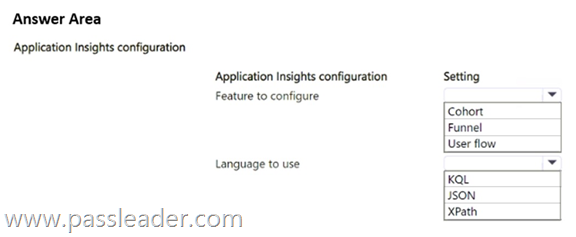
Answer: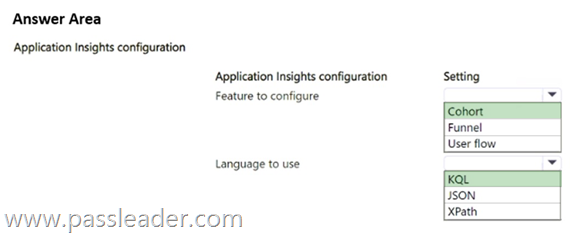
Explanation:
https://learn.microsoft.com/en-us/azure/azure-monitor/app/usage
NEW QUESTION 641
HotSpot
You have an Azure storage account named account1. The account1 account contains 100 containers named container1 through container100. You plan to implement data lifecycle management for container1 to perform the following actions:
– Move blobs to cool tier unless they have been read or modified within the last 30 days.
– Move blobs to hot tier when they are read or modified in cool tier.
You need to define the data lifecycle management policy rule to implement the container1 actions. How should you complete the rule definition? (To answer, select the appropriate options in the answer area.)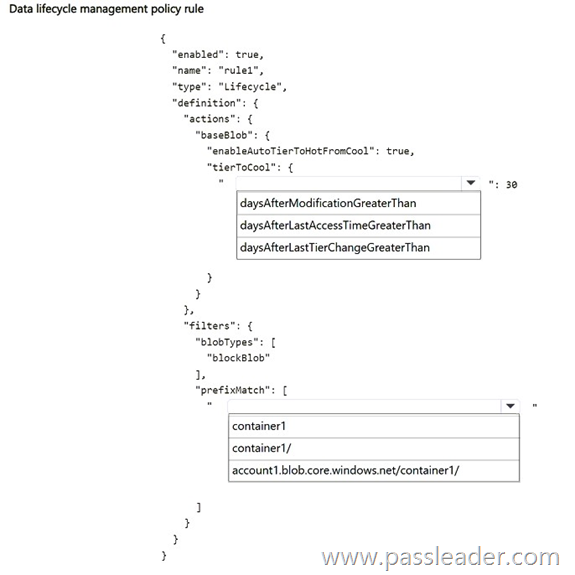
Answer: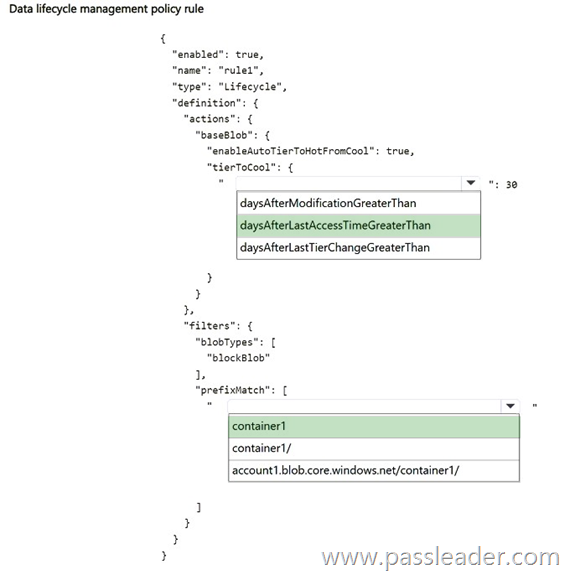
Explanation:
https://learn.microsoft.com/en-us/azure/templates/microsoft.storage/storageaccounts/managementpolicies
https://learn.microsoft.com/en-us/azure/storage/blobs/lifecycle-management-policy-structure
NEW QUESTION 642
Drag and Drop
You are developing a microservices-based application by using Azure Container Apps. The application consists of several containerized services that handle tasks, such as processing orders, managing inventory, and generating reports. You must deploy two microservices named serviceA and serviceB to support managing inventory. Deployment of the microservices have the following requirements:
– serviceA must create and configure all necessary Azure resources, including multiple Dapr components and an Azure Blob Storage account, by using Bicep files.
– serviceB must create and configure all necessary Azure resources without using Bicep files.
– All microservices must use the same resource group, environment, Azure Container Registry, and Log Analytics workspace.
You need to deploy the microservices. Which CLI command should you use? (To answer, move the appropriate CLI commands to the correct microservices. You may use each CLI command once, more than once, or not at all. You may need to move the split bar between panes or scroll to view content.)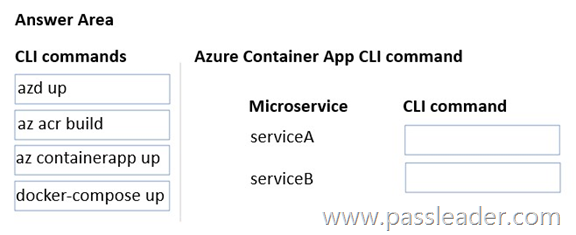
Answer: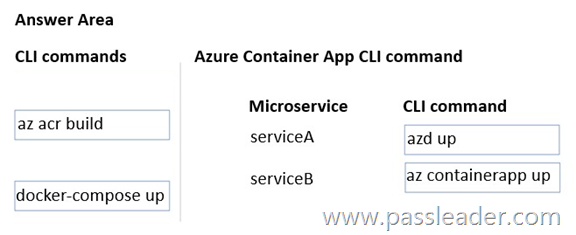
Explanation:
https://learn.microsoft.com/en-us/azure/developer/azure-developer-cli/azd-templates
https://learn.microsoft.com/en-us/cli/azure/containerapp
NEW QUESTION 643
Drag and Drop
You have an on-premises datacenter and an Azure subscription that contains an Azure Application Insights instance. You plan to implement Azure Monitor Application Insights Agent to instrument web apps hosted on the on-premises servers. You need to automate the implementation by using PowerShell. Which four PowerShell cmdlets should you run in sequence? (To answer, move the appropriate actions from the list of actions to the answer area and arrange them in the correct order.)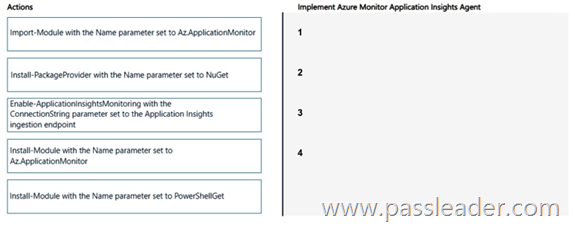
Answer: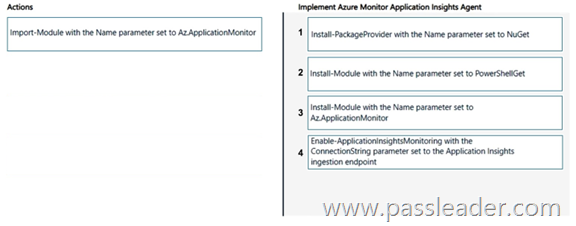
Explanation:
https://learn.microsoft.com/en-us/azure/azure-monitor/app/application-insights-asp-net-agent
NEW QUESTION 644
……
Get the newest PassLeader AZ-204 VCE dumps here: https://www.passleader.com/az-204.html (644 Q&As Dumps)
And, DOWNLOAD the newest PassLeader AZ-204 PDF dumps from Cloud Storage for free: https://drive.google.com/open?id=1_dGx5coDJPG4zq5xvUhc2LmfQ-jO_xyp